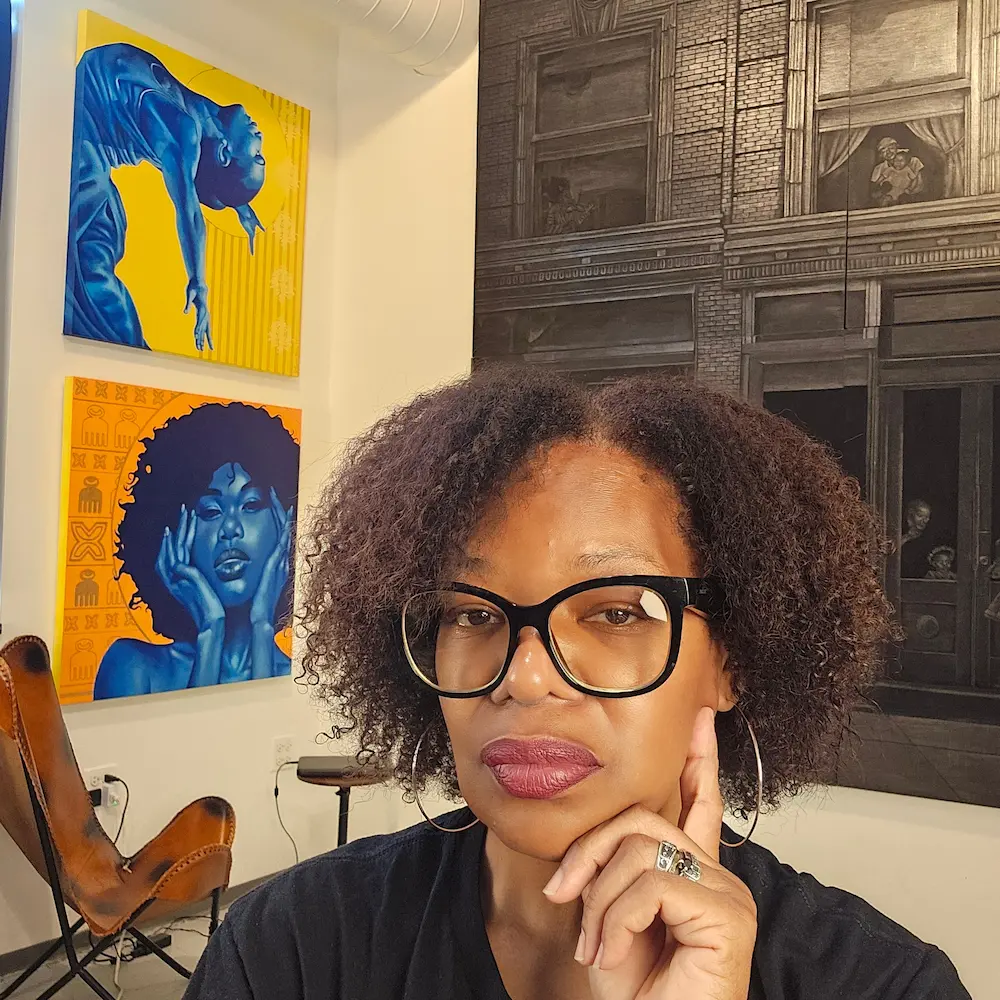
D. Lammie-Hanson is a self-taught, multidisciplinary artist working in metalpoint drawing, painting, and digital media. Raised in Harlem, New York City, and now based in Chicago, she has built a body of work centered on Black identity, spirituality, and the human spirit.
Lammie-Hanson works primarily in metalpoint — a technique dating back to the Renaissance, in which fine wires of silver or gold are drawn across a prepared surface. Her command of the medium took root during a residency in Barcelona, shaped in part by an encounter with the Black Madonna of Montserrat. That moment of inspiration continues to inform her work: using the luminous, unforgiving nature of metalpoint to render the radiance, resilience, and divinity of Black skin.
In her fusion paintings, she builds on that same foundation, combining metalpoint with acrylic and experimental surfaces to bring color and texture into the discipline of line. Deep, layered blues recur throughout this work as a way of depicting skin across the African diaspora — a visual language meant to evoke depth, memory, and ancestral light. Across both bodies of work, she describes her practice as a marriage of Renaissance technique and Afrofuturist vision.
Much of her early work centered on portraits of women, particularly Black women. Her practice later expanded to include affirming, dignified portraits of Black men, reflecting an ongoing interest in how dignity and divinity show up across her community.
Lammie-Hanson’s work has been exhibited internationally, including at the United Nations’ Palais des Nations in Geneva and at the Venice Biennale. Her paintings and drawings have appeared in museum exhibitions such as Louisiana Contemporary at the Ogden Museum of Southern Art in New Orleans, and she has held a solo show at the George Washington Carver Interpretive Museum in Dothan, Alabama.
She is the winner of the Bombay Sapphire Artisan Series New Orleans Regional competition, which led to her participation in Scope Art during Art Basel Miami. Her work has marked civic and cultural milestones as well: a series of silverpoint portraits commissioned for the New Orleans tricentennial was featured in the book 300 for 300, and she produced a body of silverpoint portraits for the 25th anniversary of the Essence Music Festival.
As a participant in the Hyde Park Art Center’s Center Program in Chicago, she produced a series of large-scale silverpoint works. One of these, Dear Beautiful Black Boy, was acquired by the Hilliard Art Museum in Lafayette, Louisiana, making her the first living artist in the museum’s permanent collection.
Among her largest works is Dared to Be Black and Shining, an eight-by-twelve-foot silverpoint drawing depicting a day in the life of her childhood neighborhood of Harlem, created during a residency at Little Black Pearl in Chicago and premiered at the Chicago Art Department. Her goldpoint series Indigo Seven: Gilded Agility, featuring renderings of professional dancers’ musculature on indigo substrates, has been shown at the International Museum of Surgical Science in Chicago.
Her ongoing Indigo Seven Series continues to explore the intersection of dance, divinity, and the transformative power of goldpoint, with monumental works often modeled on sacred architecture and rooted in themes of movement and spirit.